The workbook · $27
You've found your limiting belief — one line you decided about yourself as a child. The Pattern Beneath is the evening after: what it's been guarding, the younger you who decided it, and who you'd be without it. A PDF, $27, yours the moment you pay.
You've spent years fighting the behaviour. The need for validation — from the room, or that person — the proving, the pleasing, the numbing, the hypervigilance: reading every face, waiting in fear for the worst answer I could imagine. White-knuckling the symptom while the thing underneath went untouched.
Here's what no one ever told you: the behaviour was never the problem.
It's a symptom. It's guarding something older — a wound most of us pick up in childhood, long before we had words for it. And until you go underneath, willpower tends to keep failing, because you're fighting the symptom while the wound runs the show.
Shame is the lock. Every time you fight the behaviour and lose, the lock tightens — which is why trying harder has made it stronger, not weaker.
The Pattern Beneath is guided inner work that takes you to that wound — and the first real steps of the way through it.
You've probably tried to overwrite it. Affirmations. A new morning. A 21-day thing with a candle. And it held — for about 21 days — because they're arguing with that line, and it was decided by a child, so it doesn't answer to an adult's argument. The affirmation was self-love said to the wrong person: the adult, not the child who decided the line.
You can't overwrite what you haven't met. This takes you to meet it.
The tools you've tried stop working the moment you use them to improve yourself. They become one more way of saying you're not enough. This workbook isn't done to get better. It's done to find out what's there.
Who this is for
This is for you if you're done managing yourself.
If you've read the books, done the affirmations, and the pattern is still running. If you said no once and felt guilty for three days. If one phone call home can undo a good week. If you're waiting for the next thing to go wrong before anything's happened. If you're sure people don't really like you, and you can't point to why. If most of your energy goes on getting through the day and holding yourself together. If fear, shame and guilt are the weather you live in, not something that happens to you.
Then this isn't one more thing to try harder at. The behaviour was never the problem. It's guarding a limiting belief — one line you decided about yourself as a child. Ten minutes finds it. The workbook is the evening that goes the rest of the way.
What changed for me — and it's true: I'm not living in fear, shame and guilt. I don't spend my energy surviving the day and managing myself. I'm not hypervigilant and constantly anxious any more — I'm not reading every face, waiting in fear for the worst answer I could imagine. I have more peace, clarity and confidence than I've ever had — and I know it from the inside, not from anyone telling me. On paper, not everything has caught up yet. Inside, it already has.
When the line underneath changes, the life outside tends to rearrange around it. Self-love tends to arrive the way it left: you stop giving yourself away, and then you stop wanting to. The energy you spent managing yourself goes into making things. You stop coping and start building. Nothing gets added. Everything you're capable of was already in you, and the line was the only thing in the way. Yours starts with finding it.
Treat that line like your life runs on it. It does.
From the first readers
From people who've done it:
Replace this with a real reader reaction.— Initials, location
And this one.— Initials, location
I didn't learn this from a book. I lived it.
I didn't learn this from a book — though I read everything I could get my hands on that might just help me. I lived it. For most of my life I was a people-pleaser, wearing a mask I'd built as a child to feel worthy of love — chasing validation, measuring myself against everyone around me, carrying a scarcity I could never quite name. I numbed what I couldn't face: with drink, with substances, with whatever let me avoid myself. I stayed far too long in a relationship that was quietly breaking me, because leaving felt more frightening than staying.
And then it all came apart — my home, my relationships, my finances, the life I'd spent decades building. I reached the dark night of the soul, closer to the edge than I say lightly. What carried me through wasn't luck, and it wasn't rescue. It was a year of hard-won sobriety, and a choice that was mine alone: to finally stop running and turn inward.
I leaned into something larger than me, and spirituality became the doorway it had always been. I met my shadow instead of fleeing it. I learned to parent the frightened parts of me instead of being ruled by them. I stopped proving, and started belonging to myself. Self-love and self-worth were the foundation. Not feelings: I stopped abandoning myself just to feel wanted or get external approval, and everything else stood on that. Slowly, from that foundation, a different life took shape.
I'm still walking it — this work never ends, it only deepens. And that's why I wrote it: not from a summit I've reached, but from the path I'm still on, a few steps ahead, turning back to say — this way.
Together, we go through — not around.
What it is
Self-paced. One evening, or as slowly as you like, wherever you are, privately. Twenty-seven pages and thirty-six questions, with room to write under every one, in a PDF you download the moment you pay. No performance. No pretending. Just you, honest, with a workbook written by someone who's been down there and come back.
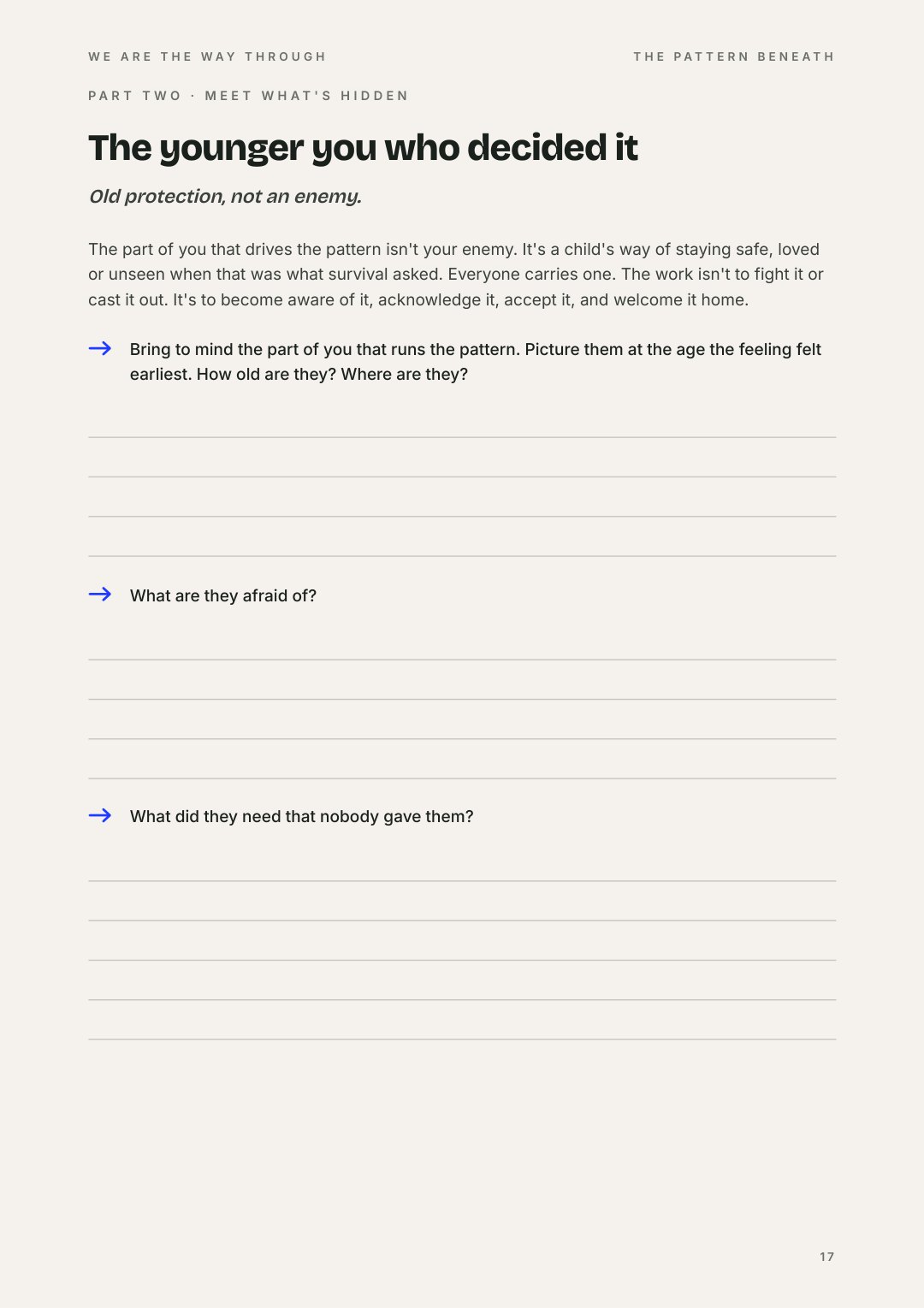
It walks you through stage one of the way through in full, See the Pattern; begins stage two, Meet What's Hidden; and makes the first move of stage three. The rest of the map is the course.
Everything you get
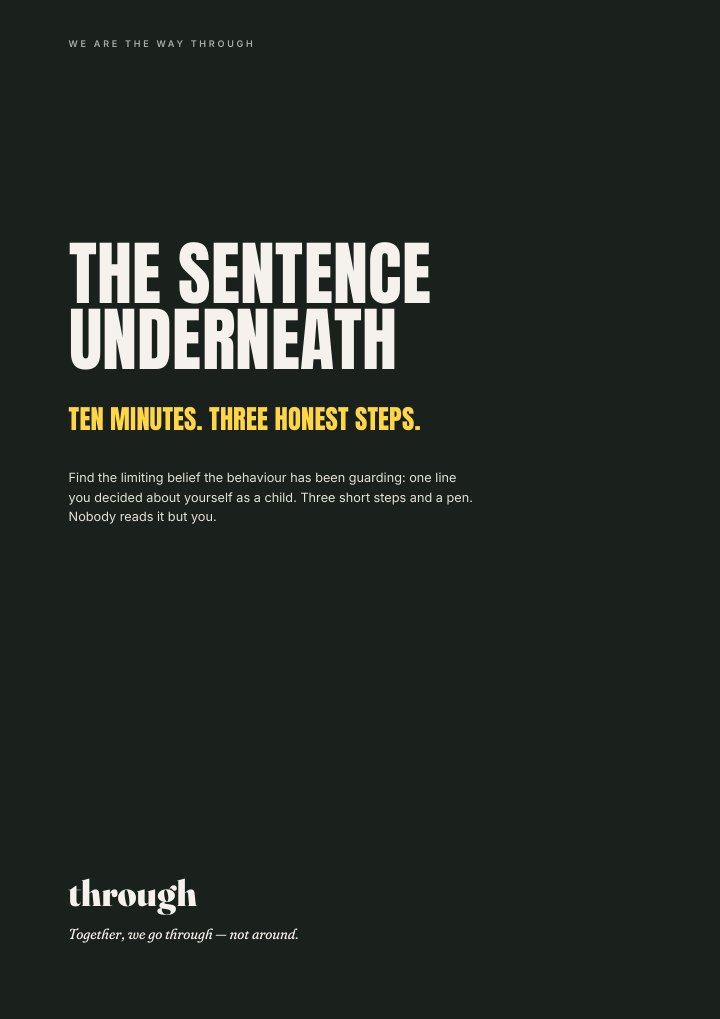
The ten-minute exercise Free
Finds the line. Three steps and a pen. If you've done it, the workbook picks up where it stops.
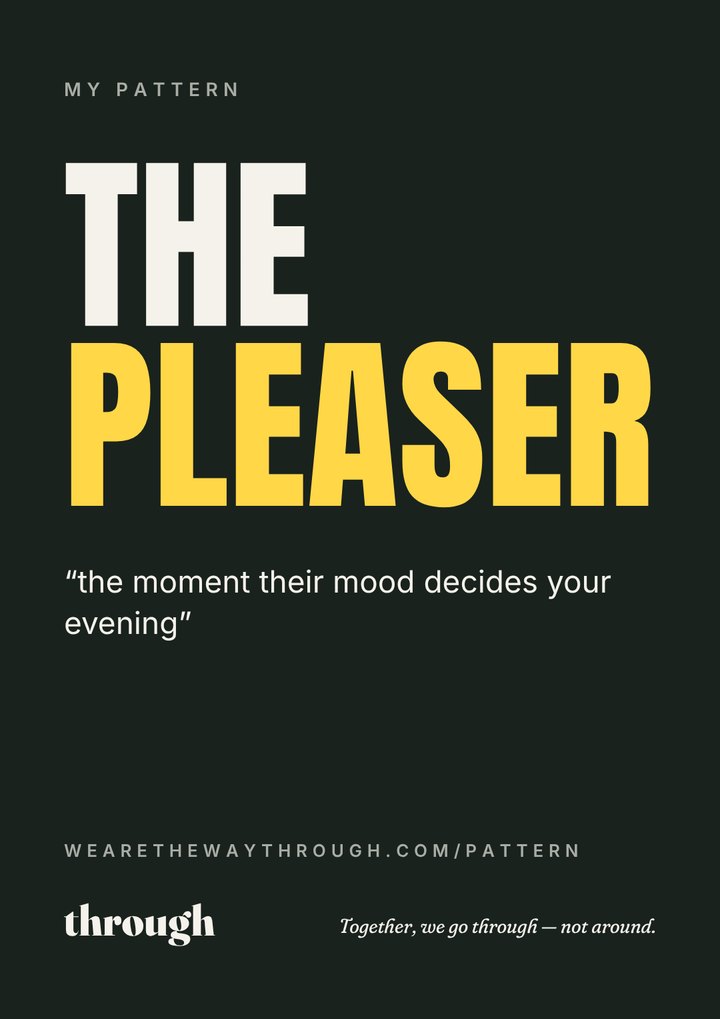
The two-minute quiz Free
Names the pattern running loudest. Seven scenes, two minutes, no sign-up to see the result.
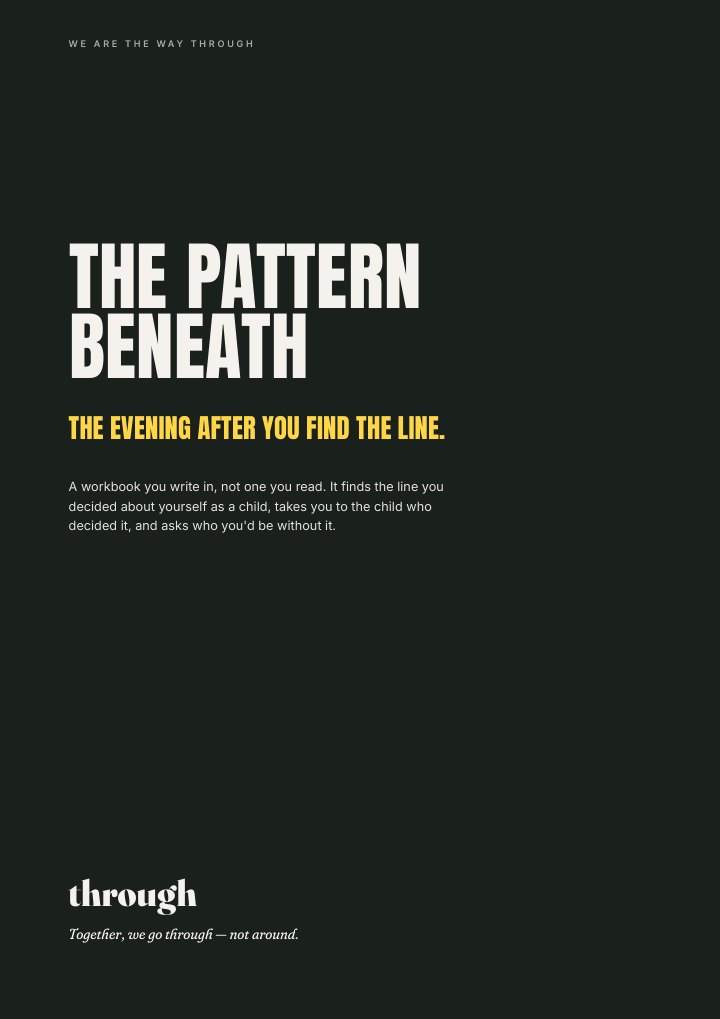
The Pattern Beneath $27
Twenty-seven pages, thirty-six questions, three parts. One evening, and the week after.
Three doors into the same room. Two are free. The third is the evening.
Inside
This asks something of you. Nobody feels ready to meet what they built a life to avoid — and readiness is made afterwards, out of having gone anyway.
What this isn't
This is one part of what people call limiting beliefs, taken all the way down. It isn't affirmations, it isn't a course, and it isn't therapy. It's one evening with one line you decided about yourself as a child.
What this does and doesn't do
This won't hand you a fixed life by Friday. Anyone promising that is selling you the same surface-fix that never held.
What it does is take you underneath — to see the pattern clearly, name the wound honestly, and feel the first real turn inward. That seeing is where every lasting change begins. It's the thing you can't unsee once you have, and the foundation the rest of the map is built on.
Real change doesn't start with the behaviour. It starts underneath it. That's what begins here.
What's actually on the other side of this
Not a fixed life by Friday. Something better, because it lasts.
Peace. The fight with yourself quiets. You stop waking up braced for the day.
Self-trust. You stop scanning that person, or the room, for approval — because you have your own. You choose from what you want, not from what keeps you small.
Freedom. The behaviour lets go of you. Not through white-knuckling — because the wound underneath it gets met.
And the ceiling tends to lift. Here's the part no one connects for you: the thing capping your life — the self-sabotage, the playing small, the undercharging, the waiting to feel "ready" — was never the timing, or luck, or discipline. It was the wound. Meet the root, and you tend to stop standing in your own way. The energy you poured into managing yourself comes free to build with — it did for me.
You are the version of you that isn't fighting itself.
That version has so much more to give — and life tends to respond to that. This is where it starts.
The questions people ask
I've done the mindset work. Why am I still doing this?
Because the work was aimed at the behaviour, and the behaviour was never the problem. It's guarding a limiting belief — one line you decided about yourself as a child — and a child's decision doesn't answer to an adult's argument.
That worked for you. Will it work for me?
I don't know. What I know is the sentence is there in everyone I've asked, and ten minutes finds it. What happens after is yours.
I don't have a trauma.
You don't need one. A sentence gets decided by a reaction, not an event — the same spilled milk, one parent angry, one not. The child who was shouted at decided something. The other didn't.
Isn't this just limiting beliefs?
Yes. One part of it, taken all the way down to where the belief was decided, and by whom.
Will it last?
The dip after is the learning, not the loss. Nothing here promises it stays; it shows you where it came from, which is the part nobody showed you.
I'm not a journaling person.
Neither was I. This isn't journaling. It's thirty-six specific questions in three parts, with room to write under each, and a week to carry what you find. A pen matters because the hand is slower than the mind, and the belief lives below the mind.
What if it brings something up?
It might. That's the point, and it's why the workbook was written to be gentle and the support note below is not fine print. Go at your pace. Reach for people. That's part of the work, not a detour from it.
I don't want to overshare.
You don't. It's a page and a pen, and nobody reads it but you. What matters isn't how much, it's whether it's true.
The one thing this does
The free ten minutes finds the line. This is the evening after: the younger you who decided it, and who you'd be without it. That's the whole of it.
One payment. Yours to keep. Start tonight.
One evening with it, and you know what the pattern's been guarding.
Confidence isn't something this builds. It's how connected to yourself you are while you do the thing — and that's what the evening is for.
Instant download · secure checkout · PDF
Together, we go through — not around.
A gentle, honest note: this is inner-growth work — a companion to support, never a replacement for it. If you're living with addiction, trauma, or thoughts of harming yourself, this sits alongside professional care, and reaching for a therapist, doctor, or crisis line isn't a detour from this work — it is this work. You don't have to go through the hardest parts alone. That's the whole point of together.
You've spent long enough fixing the wrong thing.
The way through was never more effort. It was always inward — to the pattern beneath, and the self that's been waiting under it.
Together, we go through — not around.
Why this exists
Twenty-five years handled, then it wasn't.
The behaviour was never the problem.
This says that, and shows it, and nothing else.